

Krishgen BioSystems 2026 Calendar Theme
Scientific progress is never sudden – it is cumulative. Every modern method, every assay, every therapeutic innovation, and every research workflow we rely on today has been shaped by decades of foundational discoveries.
As an Indian manufacturer serving the global life sciences community, Krishgen BioSystems believes India’s scientific story deserves greater visibility — not only for what it has achieved historically, but also for the strength of India’s scientific culture and the continued contributions of Indian researchers across disciplines today.
That belief inspired our 2026 calendar theme:
“Honouring India’s Scientific Legends.”
Each month features a scientist whose work helped define scientific thinking in their field and built frameworks that are still referenced across laboratories worldwide.
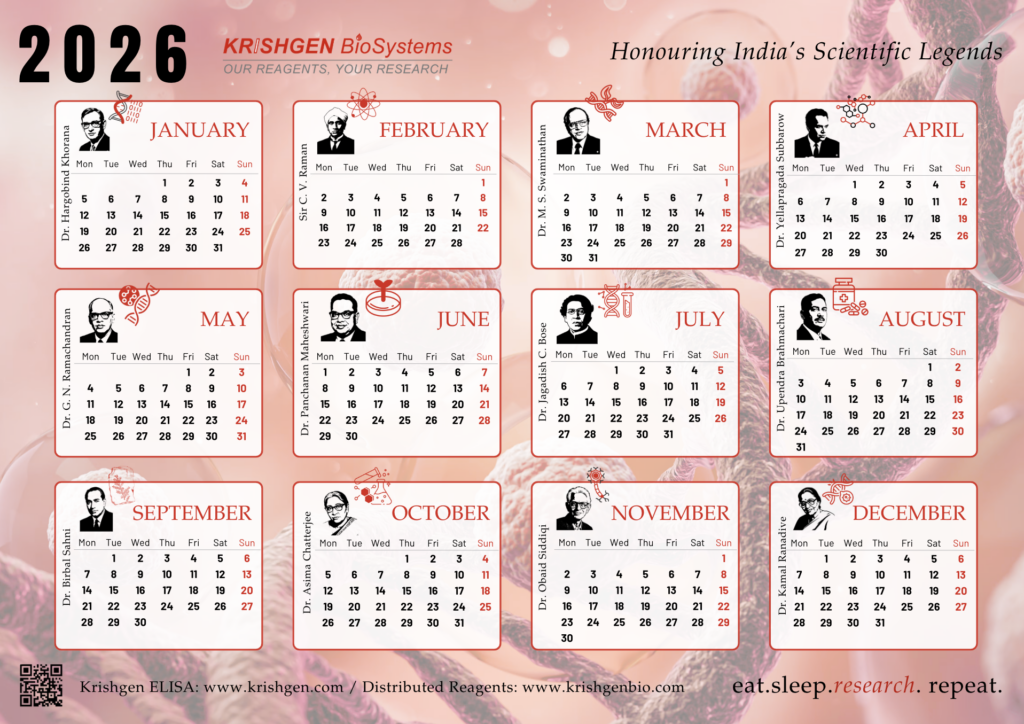
Below is a tribute to the legends featured in the calendar – their scientific journeys, landmark contributions, and the enduring foundations they helped establish.
January — Dr. Har Gobind Khorana (1922–2011)
Decoding the genetic language of life
Dr. Har Gobind Khorana was among the pioneers who transformed genetics into a mechanistic molecular language. At a time when the relationship between DNA, RNA, and proteins was still being actively deciphered, Khorana’s work helped clarify how nucleotide sequences encode amino acids.
Through elegant experiments using chemically synthesized nucleic acids and controlled translation systems, he contributed significantly to mapping codons to amino acids and strengthening understanding of the genetic code. He also advanced methods for synthesizing nucleic acids and genes, which became important milestones in the evolution of molecular biology.
Khorana’s contributions are closely tied to the foundation of genetic and molecular biology research that supports modern biotechnology and biomedical science.

February — Sir C. V. Raman (1888–1970)
The science of light interacting with matter
Sir C. V. Raman discovered the Raman Effect, demonstrating that when light interacts with a substance, a small fraction of scattered light changes in wavelength due to molecular vibrations and energy transitions.
This discovery became a cornerstone for Raman spectroscopy, a technique that allows researchers to study the molecular composition and structure of materials. Raman spectroscopy is widely used in chemistry and material sciences and is increasingly applied in biomedical and cellular analysis.
Raman’s work remains a powerful example of how fundamental physics can evolve into broadly enabling scientific tools.

March — Dr. M. S. Swaminathan (1925–2023)
Transforming agricultural biology and food security
Dr. M. S. Swaminathan was a globally respected agricultural scientist whose work contributed significantly to strengthening India’s agricultural productivity and food security. As a plant geneticist and scientific leader, he played a defining role in the scientific strategies and institutional frameworks that supported India’s Green Revolution.
His work emphasized the importance of science at scale — improved crop varieties, sustainable cultivation strategies, and linking biological research with social outcomes like nutrition and stability.
Swaminathan’s legacy continues through research in plant genetics, crop resilience, sustainable agriculture, and food systems science.

April — Dr. Yellapragada Subbarow (1895–1948)
Biochemistry and therapeutic advances that changed medicine
Dr. Yellapragada Subbarow made highly significant contributions to biomedical science, spanning both fundamental biochemistry and therapeutic development. His work advanced understanding of biological energy processes and also supported research efforts that led to major medical progress.
Subbarow contributed to research programs that resulted in important therapeutic advances, including early anticancer agents such as methotrexate, and key antibiotic developments during his time at Lederle Laboratories. His scientific work is widely recognized for its impact on medicine and public health.
His career is also a reminder that some of the most influential scientific contributions are not always the most widely known outside research circles.

May — Dr. G. N. Ramachandran (1922–2001)
The geometry of proteins: structure as biological truth
Dr. G. N. Ramachandran transformed structural biology by developing rigorous frameworks for understanding protein conformation and stability. His most widely known contribution, the Ramachandran plot, maps allowable backbone conformations of amino acids in proteins based on steric and geometric constraints.
This contribution became foundational for validating protein structures and remains a core concept in structural biology, bioinformatics, and protein modeling.
Ramachandran’s work helped establish how structural constraints shape biological function, an idea central to modern protein science.

June — Dr. Panchanan Maheshwari (1904–1966)
Plant embryology and experimental culture systems
Dr. Panchanan Maheshwari was a pioneering botanist known for major contributions to plant embryology and reproductive biology. His scientific focus helped strengthen understanding of early plant development and experimental methods for studying plant reproduction.
His work in plant embryology and experimental culture systems influenced later advances in plant tissue culture and biotechnology, supporting the scientific foundations that modern plant research continues to build upon.
Maheshwari’s legacy reflects how foundational biological work often becomes essential for long-term progress in applied science.

July — Dr. Jagadish Chandra Bose (1858–1937)
Electrical responses in plants and interdisciplinary science
Dr. Jagadish Chandra Bose was a pioneering interdisciplinary scientist whose work bridged physics, biology, and instrumentation. Through carefully designed experiments and devices, he demonstrated that plants produce measurable physiological and electrical responses to stimuli.
His contributions helped advance early thinking in plant physiology and measurement-based biological research. Bose also worked in areas related to radio and microwave science, showcasing a scientific approach that crossed disciplines long before such work became common.
His legacy is often associated with scientific curiosity, innovation in instrumentation, and interdisciplinary research thinking.

August — Dr. Upendra Nath Brahmachari (1873–1946)
A breakthrough treatment for kala-azar
Dr. Upendra Nath Brahmachari was a medical researcher known for developing Urea Stibamine, one of the earliest effective treatments for visceral leishmaniasis (kala-azar), a disease that caused widespread suffering across the Indian subcontinent.
His work improved outcomes for patients and strengthened scientific approaches to infectious disease research and treatment development.
Brahmachari’s contributions remain historically significant in tropical medicine and public health.

September — Dr. Birbal Sahni (1891–1949)
Fossil plants and Earth’s biological history
Dr. Birbal Sahni was a pioneering Indian palaeobotanist whose work advanced the study of fossil plants and their role in understanding Earth’s evolutionary and geological history.
He founded the institute that is now known as the Birbal Sahni Institute of Palaeosciences, establishing a foundation for palaeobotany and related scientific disciplines in India.
Sahni’s scientific contributions remain significant in the study of ancient biodiversity and historical environmental change.

October — Dr. Asima Chatterjee (1917–2006)
Natural products chemistry and medicinal research
Dr. Asima Chatterjee was one of India’s most respected chemists and a pioneer in natural products and medicinal chemistry. Her research involved isolating, characterizing, and studying biologically active compounds — particularly from plants — and exploring their potential therapeutic relevance.
Natural product research remains an important field in pharmaceutical science because of the chemical diversity found in nature. Chatterjee’s work is widely recognized for strengthening India’s scientific reputation in chemistry and drug discovery-related research.
Her achievements also hold deep importance as a landmark scientific career for women in India.

November — Dr. Obaid Siddiqi (1932–2013)
Genetics, behaviour, and building neuroscience research capacity
Dr. Obaid Siddiqi was a pioneering Indian scientist who contributed significantly to molecular biology and neuroscience through genetic approaches to studying behaviour, including work using Drosophila (fruit flies) as a model system.
His scientific contributions are widely associated with helping establish and strengthen modern biological research ecosystems in India, including the growth of neuroscience and molecular research capacity through institutions and scientific mentorship.
Siddiqi’s work reflects the power of model organisms and genetics in understanding complex biological function.

December — Dr. Kamala Sohonie (1911–1998)
Nutritional biochemistry and breaking scientific barriers
Dr. Kamala Sohonie was the first Indian woman to earn a PhD in a scientific discipline. She was a biochemist whose work contributed to nutritional science and metabolism-related research relevant to public health.
Her research explored biochemical and nutritional questions connected to foods and dietary components widely used in India. Beyond her scientific work, her journey remains deeply significant in the history of Indian science because it challenged barriers that previously prevented women from fully participating in scientific research.
Her legacy continues as both a scientific and cultural milestone.

Why Krishgen Created This Calendar
This calendar is not a promotional handout. It is a tribute — created by an Indian scientific manufacturer to honour the pioneers who shaped scientific thinking and helped build the foundations on which modern research stands.
These legends represent the spirit of science — curiosity, rigor, persistence, and discovery. Their work continues to inspire researchers, educators, and students, and serves as a reminder that scientific progress is built through generations.
At Krishgen BioSystems, we are proud to celebrate India’s scientific legacy — and to support global research communities as they build the next chapter.
Explore the Calendar Theme
We invite readers to revisit this page throughout the year, share it with students and researchers, and use it as a starting point to learn more about the scientists whose work continues to shape the scientific world.

