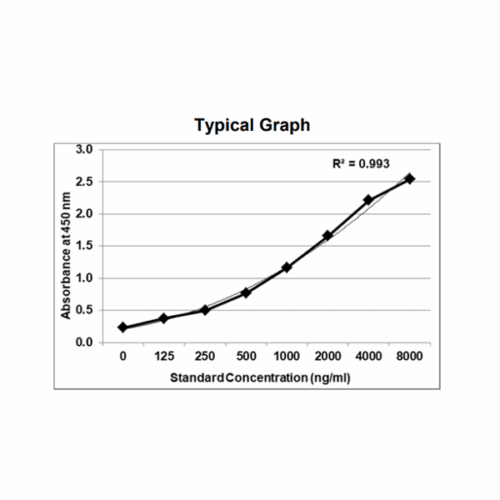
Product Overview
The KRIBIOLISA™ Semaglutide ELISA Kit (Cat. No. KBI5030) is a highly sensitive competitive immunoassay for the quantitative determination of semaglutide (Ozempic®, Wegovy®, Rybelsus®) in human serum and plasma. Validated in line with FDA/ICH ICH Q2(R1) bioanalytical method validation guidelines, this kit is engineered for researchers working in pharmacokinetics, therapeutic drug monitoring (TDM), obesity and diabetes research, and biosimilar development.
Semaglutide is a synthetic analog of human glucagon-like peptide-1 (GLP-1), engineered to resist enzymatic degradation by DPP-4, extending its half-life and therapeutic window. It comprises 31 amino acids and is conjugated to a fatty acid side chain that enhances albumin binding, prolonging its circulation time. Semaglutide is approved by the FDA under three brand names: Ozempic® (injectable, type 2 diabetes), Rybelsus® (oral, type 2 diabetes — the first oral GLP-1 receptor agonist), and Wegovy® (injectable, chronic weight management, approved June 2021). The European Medicines Agency (EMA) has approved semaglutide under the same brand names for corresponding indications.
As semaglutide prescriptions grow rapidly across diabetes, obesity, cardiovascular risk reduction, and emerging indications — and as biosimilar semaglutide candidates advance through development pipelines globally — demand for precise, validated bioanalytical tools for semaglutide measurement has surged. The KRIBIOLISA™ Semaglutide ELISA has been calibrated directly against Ozempic® injection, providing the gold-standard reference point for clinical and bioanalytical research.
The kit uses a proprietary GLP-1 monoclonal antibody immobilisation strategy, optimised to enhance semaglutide binding affinity while reducing non-specific competition from structurally related peptides including tirzepatide and exenatide. The immobilisation protocol ensures the GLP-1 antibody retains a conformation and spatial orientation highly favourable for semaglutide’s specific molecular structure — its fatty acid side chain, stabilised amino acid sequence, and GLP-1-mimetic backbone — enabling robust, selective detection in complex biological matrices.
Assay Principle
The KRIBIOLISA™ Semaglutide ELISA is a competitive binding immunoassay. Anti-GLP-1 monoclonal antibodies are pre-coated on a 96-well microplate. A constant concentration of biotinylated GLP-1 tracer and varying concentrations of unlabelled semaglutide (from standards or samples) compete for the limited binding sites on the coated antibody. The more semaglutide present in the sample, the less biotinylated GLP-1 binds to the plate. Streptavidin-HRP is then added to detect captured biotinylated GLP-1, followed by TMB substrate. The colorimetric signal is inversely proportional to semaglutide concentration and is read at OD450 nm.
The use of a GLP-1 monoclonal antibody — rather than a polyclonal or receptor-based capture — provides a highly reproducible and lot-consistent assay platform, making this kit particularly suitable for multi-centre and longitudinal studies.
Pharmacokinetic Relevance & Recommended ELISA Ranges
The assay range of 0–4,000 ng/mL was designed to encompass the full spectrum of semaglutide concentrations encountered across all approved therapeutic doses and research contexts.

The IC₅₀ of ~1,028 ng/mL falls between the Cmax values at standard and high therapeutic doses, confirming the assay is appropriately tuned for the most clinically relevant concentration window. For higher-dose studies, samples can be diluted within the validated dilutional linearity range (confirmed up to 6,400-fold) without loss of accuracy.
An assay sensitivity of <1 ng/mL is recommended for baseline detection in subjects not on semaglutide treatment; the upper working limit of ≥100 ng/mL is advised for cytokine release syndrome (CRS) or safety monitoring applications.
Validated Performance Data
Sensitivity
- LOD: 23.8 ng/mL (mean blank + 3 SD; signal-to-noise ≥ 3:1)
- LOQ: 42.1 ng/mL (mean blank + 10 SD; signal-to-noise ≥ 10:1)
- IC₅₀: ~1,028 ng/mL
Linearity & Range
% Recovery values across the standard curve range demonstrate excellent assay linearity:
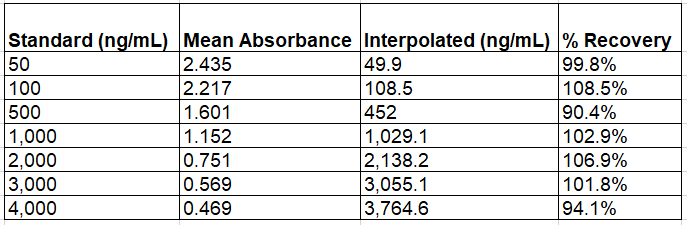
Standard curve fit: 2nd order polynomial (R² = 98.32%)
Precision & Reproducibility
Assessed across three concentration levels in triplicate over three independent runs:
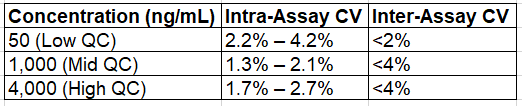
All values comfortably meet FDA/ICH acceptance criteria (≤15% CV for QC samples; ≤20% at LLOQ).
Parallelism
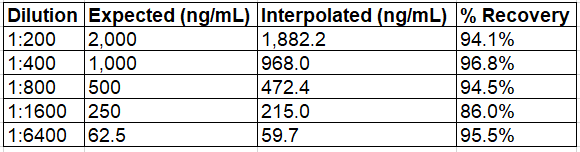
Serial dilutions of high-concentration semaglutide samples were tested in both human serum (1:200 to 1:6400) and human plasma (1:200 to 1:6400). Recovery was within the 80–120% acceptance range across the majority of dilutions in both matrices, confirming no significant matrix effect and supporting the use of sample dilutions in routine bioanalytical workflows.
Human Serum Parallelism:
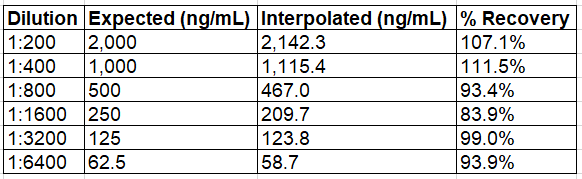
Human Plasma Parallelism:
Matrix Effect
Assay performance was compared in three conditions: buffer only, buffer + 1:100 human serum, and buffer + 1:100 human plasma. Minimal absorbance shifts and low %CV values across the full standard curve range confirm the absence of significant matrix interference from either serum or plasma. The kit was additionally tested with a physiological buffer (pH 7.4) to model tear fluid applications.
Specificity & Cross-Reactivity
The capture and detection antibodies target unique epitopes within the semaglutide molecule’s GLP-1 analog structure, demonstrating strong affinity toward both the native and acylated forms of semaglutide. The assay’s GLP-1 monoclonal antibody immobilisation strategy confers high selectivity for semaglutide over structurally related molecules. Analyte Cross-Reactivity Notes Semaglutide Primary analyte Concentration-dependent inhibition Liraglutide 100–120% Structurally similar GLP-1 analog; expect cross-detection Exenatide Minimal Confirmed in validation cross-reactivity study Tirzepatide Minimal Dual GIP/GLP-1 structure; negligible binding
Endogenous GLP-1 <0.1% Highly specific to exogenous semaglutide
GIP Negligible —
Insulin Negligible —
Important note on liraglutide: Given 100–120% cross-reactivity with liraglutide, the kit has limitations when measuring semaglutide in patients who have previously received or are co-administered liraglutide. This should be considered in study design. Similarly, semaglutide acetate and other semaglutide salt forms are detected at equivalent cross-reactivity.
In the cross-reactivity validation study, neither exenatide nor tirzepatide produced significant signal reduction across the tested concentration range (0–4,000 ng/mL), confirming that the assay is highly specific to semaglutide in mixed GLP-1 agonist environments.
Comparison with Ozempic® Reference Standard
Kit standards were directly compared against Ozempic® (branded semaglutide) injection across the full assay range (50–4,000 ng/mL), with %CV values all below 8% — confirming excellent concordance between kit standards and the reference pharmaceutical product.
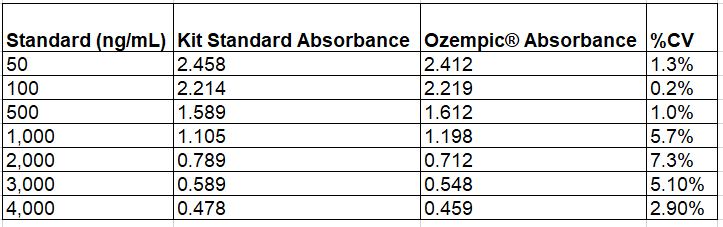
This direct calibration against Ozempic® injection, rather than synthetic peptide alone, ensures the highest possible clinical relevance for pharmacokinetic and therapeutic monitoring studies.
Applications
- Pharmacokinetic (PK) Studies — Quantify semaglutide serum and plasma concentrations across all approved dose levels (0.25–2.4 mg/week). Covers the complete clinical Cmax range from low-dose titration through high-dose obesity management.
- Therapeutic Drug Monitoring (TDM) — Monitor trough and peak semaglutide levels in clinical research settings to support dose optimisation, adherence studies, and personalised management strategies in type 2 diabetes and obesity. Particularly relevant for patients with altered absorption profiles due to hepatic or renal impairment.
- Bioavailability & Bioequivalence (BA/BE) Studies — Validated bioanalytical method suitable for BA/BE submissions for semaglutide
injectable and oral formulations. Supports both injectable (subcutaneous) and oral (Rybelsus®) bioavailability assessments. - Biosimilar Development & Characterisation — With multiple semaglutide biosimilars in development globally, this kit enables immunoreactivity equivalence testing between biosimilar candidates and Ozempic® reference
product. - Obesity & Weight Management Research — Measure semaglutide exposure in studies examining weight loss outcomes, appetite suppression mechanisms, and energy balance in the context of Wegovy® treatment (2.4 mg/week).
- Cardiovascular Outcomes Research — Support bioanalytical measurements in trials investigating semaglutide’s cardiovascular protective effects (SELECT trial outcomes, heart failure studies).
- Drug-Drug Interaction Studies — Evaluate changes in semaglutide exposure with co-administered medications including SGLT-2 inhibitors, DPP-4 inhibitors, insulin, and metformin combinations.
- Pre-clinical ADME Research — Support absorption, distribution, metabolism, and excretion studies in animal models administered semaglutide or semaglutide analogs.
- Emerging Indications Research — Non-alcoholic steatohepatitis (NASH), obstructive sleep apnoea, chronic kidney disease, Alzheimer’s disease, and other indications where semaglutide is under active clinical investigation.
Scientific Background: Semaglutide
Semaglutide is a 31-amino acid GLP-1 receptor agonist with a molecular weight of approximately 4,113 Da (PubChem CID: 56843331; DrugBank: DB13928). It differs from endogenous human GLP-1 at two positions: alanine at position 8 is replaced by 2-aminoisobutyric acid (Aib), preventing DPP-4 cleavage, and lysine at position 34 is replaced by arginine. Lysine at position 26 is further acylated with a C-18 fatty diacid chain via a spacer, conferring high albumin binding affinity and an approximately 7-day plasma half-life — enabling the once-weekly subcutaneous dosing regimen. Rybelsus® (oral semaglutide) uses an absorption enhancer (SNAC) to facilitate GI absorption, with bioavailability of approximately 1%.
Semaglutide activates GLP-1 receptors in the pancreas (stimulating glucose-dependent insulin secretion, suppressing glucagon), the hypothalamus (reducing appetite and food intake), and the gastrointestinal tract (slowing gastric emptying). These combined mechanisms produce both glycaemic control and significant, sustained weight reduction. The SURPASS, SUSTAIN, and STEP clinical trial programmes have established semaglutide as a cornerstone of modern metabolic disease management.
Regulatory approvals:
- Ozempic® (injectable, type 2 diabetes): FDA approval October 2017; EMA approved
- Rybelsus® (oral, type 2 diabetes): FDA approval September 2019; first oral GLP-1 agonist approved
- Wegovy® (injectable 2.4 mg, chronic weight management): FDA approval June 4, 2021; EMA approved
Kit Contents
Component Description Quantity Anti-GLP-1 Coated Microplate 96-well polystyrene (12 × 8 strips), anti-GLP-1 monoclonal antibody coated 1 × 96 wells Semaglutide Standard Recombinant semaglutide, lyophilised, 4,000 ng/mL 2 vials GLP-1 Biotin Concentrated Biotinylated GLP-1 tracer 1 vial (10 µL)
- Streptavidin: HRP Conjugate Concentrated 1 vial (10 µL) Standard Diluent (1X) Buffered protein base + 1:100 human serum 10 mL Sample Diluent (1X) Buffered protein base + BSA 50 mL
- Streptavidin: HRP Diluent Buffer with protein stabiliser 12 mL Biotin Diluent Buffer with protein stabiliser 10 mL Wash Buffer (20X) Concentrated buffered surfactant 25 mL TMB Substrate Stabilised chromogen 12 mL Stop Solution 0.73M phosphoric acid 12 mL Instruction Manual — 1
Sample Preparation
- Specimen collection: Venous blood collected by venipuncture. Separate serum by centrifugation after clotting; plasma may also be used. Do not use lipaemic, haemolytic, or microbially contaminated samples.
- Required dilution: Serum and plasma samples must be diluted 1:100 (v/v) prior to assay (1 µL sample + 99 µL Sample Diluent).
- Storage: Samples stable at 2–8°C for up to 3 days; long-term storage at −20°C. Avoid repeated freeze-thaw cycles; aliquot prior to storage.
Assay Protocol Summary
- Bring all components to room temperature (18–25°C) for 30 minutes before use
- Pipette 100 µL of standards or diluted samples into respective wells
- Incubate 90 minutes at 37°C
- Add 50 µL working biotinylated GLP-1 to each well
- Incubate 90 minutes at 37°C
- Wash 4× with Wash Buffer (1X)
- Add 100 µL working Streptavidin:HRP conjugate
- Incubate 60 minutes at 37°C
- Wash 4× with Wash Buffer (1X)
- Add 100 µL TMB substrate; incubate 30 minutes at 37°C in dark
- Add 100 µL stop solution (blue → yellow)
- Read absorbance at 450 nm within 10–15 minutes
Frequently Asked Questions
1. What is the detection range of the Krishgen Semaglutide ELISA Kit?
The assay range is 0–4,000 ng/mL, with an LOD of 23.8 ng/mL and LOQ of 42.1 ng/mL. The kit has been validated for dilutional linearity up to 6,400-fold, covering the complete clinical Cmax range for all semaglutide doses and indications.
2. Which brands of semaglutide does this kit detect?
The kit detects semaglutide regardless of formulation or brand. It quantifies the active semaglutide molecule in samples from patients receiving Ozempic® (injectable), Wegovy® (injectable, high dose), or Rybelsus® (oral). It has been calibrated directly against Ozempic® injection as the reference standard.
3. Does the semaglutide ELISA cross-react with tirzepatide?
No. Tirzepatide shows minimal to no binding in the KRIBIOLISA™ Semaglutide ELISA, confirmed in head-to-head cross-reactivity studies. This is important for laboratories working with patients who have switched from semaglutide to tirzepatide or vice versa.
Note: For tirzepatide quantification, Krishgen offers a dedicated Tirzepatide ELISA Kit (KOD1027) using a different capture strategy.
4. Does the kit cross-react with endogenous GLP-1?
Cross-reactivity with endogenous GLP-1 is <0.1%, ens