About the Tirzepatide ELISA Kit:
The KRIBIOLISA™ Tirzepatide ELISA Kit (Cat. No. KOD1027) is a highly sensitive competitive ELISA designed for the quantitative determination of tirzepatide (LY3298176, Mounjaro®, Zepbound®) in human serum and plasma. The assay has been validated in accordance with FDA/ICH ICH Q2(R1) bioanalytical method validation guidelines, confirming its suitability for pharmacokinetic (PK) studies, therapeutic drug monitoring, and biosimilar development.
Tirzepatide is a first-in-class dual GIP (glucose-dependent insulinotropic polypeptide) and GLP-1 (glucagon-like peptide-1) receptor agonist, approved by the FDA in May 2022 under the brand name Mounjaro® for type 2 diabetes management, and subsequently under the brand name Zepbound® in November 2023 for chronic weight management in adults with obesity. As tirzepatide clinical use and biosimilar development accelerates globally, demand for precise, validated bioanalytical tools has grown rapidly.
The KRIBIOLISA™ Tirzepatide ELISA employs a proprietary GLP-1 receptor (GLP-1R) immobilization strategy that optimises receptor orientation on the assay plate, enhancing selective tirzepatide binding while minimising cross-reactivity with other GLP-1 receptor agonists such as semaglutide — a critical advantage for laboratories running multi-drug PK panels.
IC₅₀~345 ng/ml
Intra-Assay CV<12% and Inter-Assay CV<10%
Assay Principle
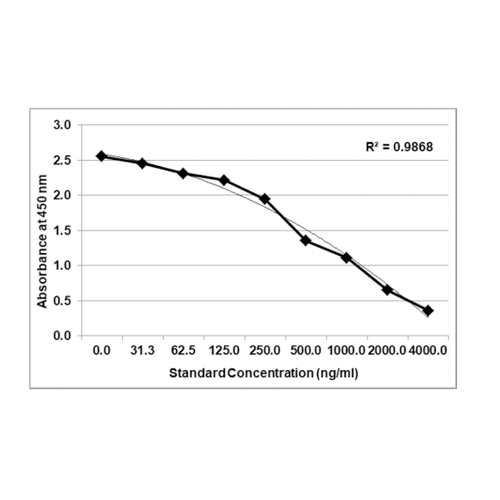
The KRIBIOLISA™ Tirzepatide ELISA is based on the principle of competitive enzyme immunoassay. The GLP-1 receptor (GLP-1R) capture protein is immobilised on the microplate using a proprietary orientation protocol that maintains a conformation highly favourable for tirzepatide binding. Standards or samples are added to the wells, where tirzepatide competes with a labelled tracer for binding to the immobilised GLP-1R. Signal (% absorbance at OD450) is inversely proportional to tirzepatide concentration. A standard curve is generated across the 0–4,000 ng/mL range and used to interpolate unknown sample concentrations.
This receptor-based capture strategy is fundamentally different from antibody-based tirzepatide ELISA formats and provides enhanced molecular selectivity based on the native receptor-ligand interaction.
Pharmacokinetic Relevance
A primary application of this tirzepatide ELISA is in pharmacokinetic profiling during clinical and pre-clinical studies. The assay’s quantification range was specifically validated to cover clinically observed tirzepatide Cmax values:

The IC₅₀ of ~345 ng/mL closely aligns with the Cmax at the 5 mg therapeutic dose, confirming the assay’s sensitivity at the most clinically relevant concentration window. For higher-dose studies or concentrated samples, the assay supports dilution of samples to remain within the validated linear dynamic range. The half-life of tirzepatide (~5 days with once-weekly subcutaneous dosing) and its distribution profile make this ELISA suitable for trough level monitoring, area under the curve (AUC) estimation, and steady-state concentration analysis.
Validated Performance Data
Sensitivity & Range
- Detection Range: 0 – 4,000 ng/mL
- LOD: ~20 ng/mL (OD450 = 2.4582)
- LOQ: ~50 ng/mL (OD450 = 2.4037)
- LLOQ: 30 ng/mL
Precision & Reproducibility
Precision was assessed by analysing three standard concentrations (31.3, 500, and 2,000 ng/mL) in triplicate across three independent assay runs.

All precision values meet FDA/ICH acceptance criteria for bioanalytical method validation.
Parallelism
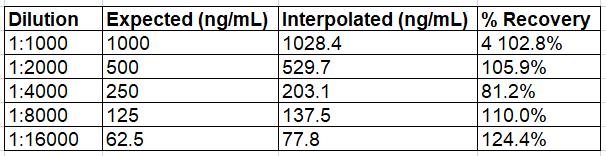
Serial dilutions of a high-concentration tirzepatide sample (1:1000 to 1:16000) were assessed against the standard curve. Percent recovery fell within the 80–120% acceptance range for the majority of dilutions, confirming that biological sample dilution does not significantly affect assay accuracy.
Matrix Effect
No significant matrix effect was observed when comparing assay performance in buffer versus buffer spiked with 1:1000 human serum. Across the full standard curve range (0–4,000 ng/mL), %CV values remained below 3%, confirming the kit’s robustness for use with biological matrices.
Specificity & Cross-Reactivity
The specificity of the KRIBIOLISA™ Tirzepatide ELISA was evaluated against two clinically relevant GLP-1 receptor agonists: exenatide and semaglutide. Analyte Receptor Inhibition Profile Cross-Reactivity Tirzepatide GIP + GLP-1 Strong, concentration dependent Primary analyte Exenatide GLP-1 Weaker inhibition Limited Semaglutide GLP-1 Minimal signal reduction Negligible / None
At 500 ng/mL: Tirzepatide reduced signal to 37.4%; Exenatide reduced signal to 52.6% (weaker inhibition); Semaglutide showed no significant inhibition.
At 1,000 ng/mL: Tirzepatide reduced signal to 19.8%; Exenatide reduced signal to 36.6%; Semaglutide remained without significant binding.
This selectivity profile confirms that the KRIBIOLISA™ Tirzepatide ELISA will not be confounded by residual semaglutide in patient samples from switch-over studies or combination therapy contexts. For semaglutide quantification, Krishgen offers a separate dedicated ELISA using a different capture protein strategy.
Comparison with Reference Standards
Comparison with Mounjaro® Injection
Tirzepatide kit standards were compared directly against Mounjaro® (branded tirzepatide) injection across the full assay range. %CV values ranged from 6.24% to 12.83%, well within acceptable limits, confirming concordance between the kit standard and the reference pharmaceutical.
Comparison with Commercial Tirzepatide Biosimilar
The kit was further tested against a commercially sourced tirzepatide biosimilar injection. This data supports the kit’s application in biosimilar development and characterisation, including bioequivalence studies comparing innovator Mounjaro® to biosimilar candidates.
Applications
The KRIBIOLISA™ Tirzepatide ELISA Kit is suitable for the following research and bioanalytical applications:
- Pharmacokinetic (PK) Studies — Quantify tirzepatide serum/plasma concentrations in single-dose and multi-dose PK studies across the full therapeutic dose range (5–15 mg).
- Bioavailability & Bioequivalence (BA/BE) Studies — Validated bioanalytical method suitable for regulatory BA/BE submissions involving tirzepatide or its biosimilars.
- Therapeutic Drug Monitoring — Measure trough and peak tirzepatide levels in clinical research settings to support dose optimisation or adherence investigations.
- Biosimilar Development & Characterisation — Assess immunoreactivity of tirzepatide biosimilar candidates relative to Mounjaro® reference standard.
- Drug-Drug Interaction Studies — Evaluate changes in tirzepatide exposure in the context of co-administered medications, particularly SGLT-2 inhibitors and insulin combinations.
- Pre-clinical Research — Support ADME studies and in vivo pharmacology in animal models where tirzepatide or tirzepatide analogues are administered.
- Clinical Trial Sample Analysis — Process and quantify samples from clinical trials investigating tirzepatide for type 2 diabetes, obesity, sleep apnoea, NASH, and cardiovascular outcomes.
Scientific Background: Tirzepatide
Tirzepatide (LY3298176) is a 39-amino-acid synthetic linear peptide conjugated to a C20 fatty diacid moiety, with a molecular weight of 4,813.45 Da (chemical formula C₂₂₅H₃₄₈N₄₈O₆₈). It functions as a dual incretin receptor agonist, activating both the GIP receptor and GLP-1 receptor simultaneously — a mechanism that distinguishes it from earlier GLP-1 receptor agonists such as liraglutide, semaglutide, and exenatide, which target GLP-1R only.
By co-activating both incretin receptors, tirzepatide promotes glucose-dependent insulin secretion, reduces glucagon secretion, slows gastric emptying, and suppresses appetite — collectively producing superior glycaemic control and weight reduction outcomes versus GLP-1 monotherapy. Tirzepatide has a plasma half-life of approximately 5 days, enabling once-weekly subcutaneous dosing. It is primarily eliminated via renal excretion, with proteolytic cleavage of the amino acid backbone as the principal metabolic pathway.
Regulatory approvals:
- Mounjaro® (type 2 diabetes): FDA approval May 13, 2022; European Commission approval September 15, 2022
- Zepbound® (chronic weight management): FDA approval November 8, 2023
Presented at AAI Immunology Annual Meeting 2025
Krishgen BioSystems presented validation data for the KRIBIOLISA™ Tirzepatide ELISA at the AAI Immunology Annual Meeting 2025. The poster covers the competitive ELISA design, receptor-based capture strategy, cross-reactivity profiling, and pharmacokinetic relevance of the assay.
Download the AAI 2025 Poster →
Downloads & Resources
- Validation Guide — Full FDA/ICH ICH Q2(R1) validation report for KOD1027 including precision, parallelism, matrix effect, and cross-reactivity data. Download PDF →
- AAI 2025 Conference Poster — Presented validation data and assay Download PDF →
- Kit Insert / Protocol — Step-by-step assay procedure
Frequently Asked Questions
1. What is the detection range of the Krishgen Tirzepatide ELISA Kit?
The assay range is 0–4,000 ng/mL, with an LLOQ of 30 ng/mL and LOD of approximately 20 ng/mL.
2. Does the Tirzepatide ELISA cross-react with semaglutide?
No. Semaglutide showed minimal to no binding in the KRIBIOLISA™ Tirzepatide ELISA across all tested concentrations, confirming negligible cross-reactivity. This is due to the GLP-1R immobilisation strategy, which favours tirzepatide’s unique molecular architecture.
3. Is this ELISA validated for human PK studies?
Yes. The assay was validated per FDA/ICH ICH Q2(R1) guidelines and covers the clinical Cmax range of tirzepatide at all approved therapeutic doses (5–15 mg), making it suitable for regulatory pharmacokinetic study submissions.
4. Can the kit be used for biosimilar testing?
Yes. Comparison studies were conducted against both Mounjaro® injection and a commercial tirzepatide biosimilar, demonstrating the kit’s utility for biosimilar characterisation and BA/BE research.
5. What sample types are compatible?
The kit is validated for human serum and plasma. PBS-based diluents (pH 7.4) offer reliable performance across the standard curve range.
6. Does this kit differentiate between Mounjaro and Zepbound?
Both Mounjaro® and Zepbound® contain tirzepatide as the active ingredient. This kit quantifies tirzepatide itself regardless of brand or formulation.
7. Can I use this kit for non-human samples?
The validation was performed with human matrices. Contact our technical team at sales1@krishgen.com to discuss use with non-human samples.