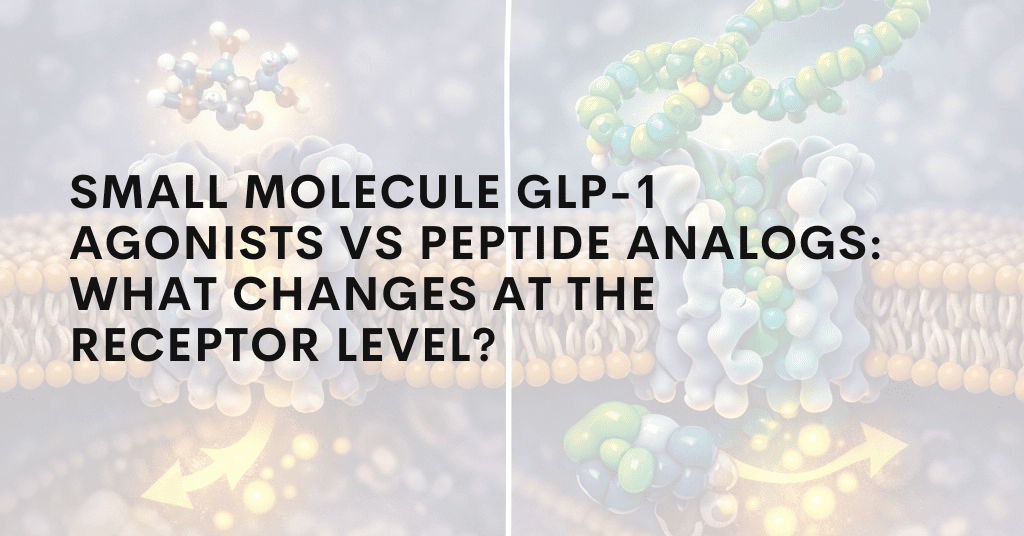
Oral small molecule GLP-1 receptor agonists represent a significant shift in metabolic pharmacology. Where peptide analogs like Semaglutide and Liraglutide are large, acylated peptides that must be injected subcutaneously, small molecules such as Orforglipron (LY3502970) and Danuglipron are orally bioavailable compounds that fit entirely within the transmembrane binding pocket of GLP-1R. They activate the same receptor but via a fundamentally different binding mode and that difference has consequences that extend from receptor conformation and signalling bias through to drug half-life, tissue distribution, pharmacokinetics, and the assay approaches required to measure them.
GLP-1R Structure: Two Binding Sites, Two Drug Classes
The GLP-1 receptor is a class B G protein-coupled receptor (GPCR) with a distinctive two-domain architecture that explains why it can be activated by such structurally diverse molecules. Understanding this architecture is the starting point for understanding why peptide and small molecule agonists behave differently.
GLP-1R consists of a large extracellular domain (ECD) also called the N-terminal domain that projects into the extracellular space, and a transmembrane domain (TMD) consisting of the canonical seven-helix bundle embedded in the cell membrane. The ECD and TMD are connected by a stalk region, and together they form the complete ligand-binding architecture of the receptor.
Native GLP-1 (7-36 amide) engages both domains in a two-step binding model. The C-terminal alpha-helical portion of GLP-1 (residues 11-36) binds to the ECD this is the “address” component that docks the peptide to the receptor surface. The N-terminal portion of GLP-1 (residues 7-10, the “message” region) then inserts into the TMD orthosteric binding site and triggers receptor activation. Both binding interactions are required for full agonist activity of native GLP-1.
Peptide analogs like Semaglutide and Liraglutide follow the same two-step binding mechanism their engineered sequences retain the critical N-terminal activation motif and C-terminal alpha-helix for ECD binding, while modifications (C18/C20 fatty acid chains, amino acid substitutions) confer protease resistance and albumin binding. Tirzepatide uses the same broad architecture but with a GIP-derived N-terminus and GLP-1R-accommodating C-terminus.
Small molecule GLP-1R agonists take an entirely different approach: they do not engage the ECD at all. They bind exclusively within the TMD inserting into a pocket formed by the transmembrane helices that is distinct from the orthosteric peptide binding site. This allosteric-like binding mode within the TMD activates the receptor without the ECD engagement that peptide agonists require.
The Transmembrane Binding Pocket: Where Small Molecules Live
Cryo-electron microscopy structures of GLP-1R bound to small molecule agonists, published between 2020 and 2024, revealed the detailed molecular architecture of the TMD binding site. The pocket is formed primarily by transmembrane helices 1, 2, 3, 5, 6, and 7, with contributions from extracellular loops 1 and 2. It is a hydrophobic cavity that is accessible from the extracellular face and partially overlaps with the binding site for the N-terminal activation domain of GLP-1 peptide.
Small molecule agonists such as Orforglipron and Danuglipron occupy this pocket and make contacts with a specific set of residues that are critical for receptor activation particularly a cluster of polar residues in the upper transmembrane region (including His363, Glu364, Thr7.42) that form hydrogen bonds with the small molecule. These interactions stabilise the active receptor conformation in a manner that is functionally analogous to, but structurally distinct from, what the N-terminal “message” segment of GLP-1 achieves.
The key structural consequence: small molecules stabilise the active receptor conformation through a different set of receptor contacts than peptides. This is not a trivial distinction the specific contacts made during activation influence which intracellular signalling partners are recruited, how strongly-arrestin is engaged, and whether receptor internalisation occurs at the same rate as with peptide agonists. These differences are captured in the concept of biased agonism.
Biased Agonism: Same Receptor, Different Signalling Outcomes
When a GPCR is activated, it does not simply turn on or off it adopts distinct conformational states that preferentially engage different intracellular signalling partners. For GLP-1R, the two most clinically relevant signalling pathways are Gas-mediated cAMP accumulation (the primary insulin-secretion pathway) and-arrestin recruitment (which drives receptor internalisation and desensitisation). A ligand that preferentially activates one pathway over the other relative to a balanced reference agonist is said to be biased.
Biased agonism has real physiological and pharmacological consequences. A GLP-1R agonist with strong-arrestin bias would rapidly internalise the receptor after binding reducing the number of GLP-1Rs at the cell surface and diminishing the insulin secretion response over time. A cAMP-biased agonist would maintain prolonged Gas signalling with less receptor internalisation, potentially producing more sustained insulin secretion for the same occupancy.
Biased Agonism Profiles Known GLP-1R Agonists
Native GLP-1 (7-36 amide): The reference balanced agonist. Activates Gas-cAMP and recruits-arrestin-1/2 in roughly proportional measure. Rapid receptor internalisation (but native GLP-1 is also rapidly degraded, so receptor resensitisation occurs quickly).
Exendin-4 (Exenatide): Mildly-arrestin biased relative to GLP-1 higher-arrestin recruitment than GLP-1 at equivalent Gas activation. Stronger receptor internalisation. The molecular basis is the C-terminal Trp-cage motif unique to exendin-4 that makes additional ECD contacts absent in native GLP-1.
Semaglutide / Liraglutide: Both show moderate cAMP bias relative to balanced native GLP-1 maintained Gas signalling with somewhat reduced-arrestin engagement than exendin-4. Albumin binding likely limits receptor occupancy kinetics, slowing internalisation.
Tirzepatide (at GLP-1R): Marked cAMP bias substantially lower-arrestin recruitment than equiactive concentrations of GLP-1 or Semaglutide. This is one of the proposed mechanisms for Tirzepatide’s superior weight loss: sustained hypothalamic GLP-1R cAMP signalling with reduced desensitisation via-arrestin.
Orforglipron / Danuglipron (small molecules): Both appear to be cAMP-biased relative to peptide balanced agonists, based on in vitro pharmacology data published to date. Small molecule binding within the TMD may structurally favour Gas-coupling conformations over-arrestin-coupling conformations due to the different receptor contact surface involved.
What This Means for Insulin Secretion and Appetite Suppression
If small molecule GLP-1R agonists are cAMP-biased, they might be expected to produce robust glucose-stimulated insulin secretion (cAMP-dependent) but potentially different effects on appetite (which involves-arrestin signalling in some hypothalamic pathways, and cAMP in others). The early clinical data is beginning to address this.
Orforglipron Phase II results (NEJM, 2023) showed HbA1c reductions of 1.3-2.1% and weight reductions of 7.9-14.7% over 36 weeks comparable in direction to peptide agonists, though with some dose-response differences that may reflect the distinct pharmacokinetics. Danuglipron (Pfizer) Phase II results were less favourable effective for glucose control but with significant GI side effect burden that led to programme modifications. The side effect profile is one area where small molecule vs peptide differences may be clinically meaningful.
Pharmacokinetics: The Oral Bioavailability Revolution and Its Consequences
The most practically significant difference between small molecule and peptide GLP-1R agonists is oral bioavailability. Peptide GLP-1R agonists cannot be administered orally in conventional tablet form they are degraded by gastric acid and intestinal proteases before reaching systemic circulation. Semaglutide tablets (Rybelsus) use a sodium caprate absorption enhancer with highly specific formulation requirements (taken with no more than 4 oz water, 30 minutes before any food) to achieve a bioavailability of approximately 1%. Small molecules, by contrast, are orally bioavailable at conventional tablet doses with no special administration requirements.
This oral bioavailability difference produces a dramatically different pharmacokinetic profile:
| PK Parameter | Peptide Analogs (Semaglutide, Liraglutide) | Small Molecule Agonists (Orforglipron, Danuglipron) | Significance |
|---|---|---|---|
| Administration route | Subcutaneous injection (weekly or daily) | Oral tablet (once daily) | Patient compliance; no injection site reactions |
| Half-life | Semaglutide: ~7 days; Liraglutide: ~13h | Orforglipron: ~30h; Danuglipron: ~8h | Dosing frequency; steady-state fluctuation |
| Peak-to-trough ratio | Low (flat PK for weekly dosing) | Higher (once daily; pronounced peak-trough) | Postprandial vs fasting GLP-1R engagement ratio differs |
| Plasma protein binding | >99% albumin-bound (via fatty acid chain) | Varies; generally lower albumin binding | Volume of distribution; tissue penetration may differ |
| Tissue distribution | Limited by size and albumin binding; CNS penetration low | Potentially greater CNS penetration (lower MW, not albumin-bound) | Hypothalamic appetite signalling may be more direct |
| Elimination | Proteolysis / renal filtration (metabolites) | Hepatic CYP450 metabolism; renal excretion | Drug-drug interactions profile differs |
| Molecular weight | ~4,000 Da (Semaglutide) large peptide | ~400-600 Da true small molecule | Immunogenicity, assay detectability, tissue penetration |
Immunogenicity: A Fundamental Difference
Peptide GLP-1R agonists, being large modified peptides, carry a theoretical risk of immunogenicity the induction of anti-drug antibodies (ADA) that could neutralise the drug or cause immune reactions. In practice, immunogenicity with approved GLP-1 peptide analogs is low: ADA incidence with Semaglutide is reported at <1% in SUSTAIN trials, with no confirmed cases of loss of glycaemic effect or hypersensitivity attributable to ADA. However, monitoring for immunogenicity remains a regulatory requirement for all biologic drugs in development, necessitating ADA/nAb ELISA as part of the PK/immunogenicity package.
Small molecule GLP-1R agonists, being low-molecular-weight compounds, are not immunogenic in the same way. They are too small to be recognised as antigens by the adaptive immune system. This means there is no requirement for ADA monitoring, no risk of neutralising antibody formation, and no regulatory need for immunogenicity ELISA as part of the clinical programme. This is one of the significant practical advantages of small molecule over peptide agonists for drug development.
The corollary for assay design: because small molecules are not immunogenic, the bridging or indirect ELISA formats used for peptide ADA detection are irrelevant for small molecule drugs. Drug PK measurement for small molecules uses mass spectrometry (LC-MS/MS) as the standard bioanalytical method, rather than ELISA the small, structurally defined molecule is better suited to mass-based detection than to immunological capture.
Drug Assay Implications: Why Small Molecules Are Not Measured by ELISA
This is a practically important point for researchers transitioning from peptide to small molecule GLP-1R agonist studies. Competitive ELISA the gold standard for peptide GLP-1 drug PK measurement (Semaglutide ELISA KBI5030, Tirzepatide ELISA KOD1027, Liraglutide ELISA KBI5020) depend on immunological recognition of the drug by a specific antibody or receptor protein. These assays exploit the antigenicity of the large peptide molecule.
Small molecules at 400-600 Da are generally too small to generate a reliable antibody response and are difficult to immobilise as capture antigens without losing their native binding conformation. Ligand binding ELISA for small molecules is technically challenging and rarely validated to the standard required for regulated bioanalysis. Instead:
LC-MS/MS (liquid chromatography tandem mass spectrometry) is the regulatory standard for small molecule drug PK measurement. It provides quantification based on the unique mass-to-charge ratio (m/z) of the drug molecule, independent of immunological recognition. LC-MS/MS is the method used for Orforglipron and Danuglipron PK quantification in all Phase I-III clinical trials.
For researchers working with both peptide and small molecule GLP-1R agonists in the same study (for example, comparing mechanisms of action), this means using ELISA for the peptide arm (KBI5030 for Semaglutide) and LC-MS/MS for the small molecule arm two different bioanalytical platforms. Pharmacodynamic biomarkers (adiponectin, ghrelin, FGF-21, etc.) can be measured using the same ELISA in both arms, as these are endogenous proteins rather than drugs.
Receptor Internalisation and Sustained vs Transient Activation
One of the most pharmacologically interesting differences between peptide and small molecule GLP-1R agonists concerns receptor trafficking. When peptide GLP-1R agonists bind and activate GLP-1R,-arrestin is recruited and the receptor-ligand-arrestin complex is internalised into endosomes. Inside endosomes, the receptor may continue to signal (referred to as endosomal cAMP signalling demonstrated for GLP-1R and other GPCRs), or may be degraded or recycled to the cell surface.
Small molecule agonists, because they bind within the TMD, may have a different internalisation profile. The structural evidence suggests that small molecule binding produces a receptor conformation with lower -arrestin affinity meaning less internalisation, more sustained surface-receptor cAMP signalling, but potentially different endosomal signalling. Whether this produces a clinically meaningful difference in the duration or character of insulin secretion responses in vivo is an active research question.
For researchers using GLP-1R agonists as pharmacological tools in cell biology experiments (rather than as therapeutic agents), this trafficking difference is highly relevant. Small molecule agonists may be preferable for experiments requiring sustained cAMP elevation without receptor desensitisation. Peptide agonists particularly Exenatide drive robust internalisation and are useful for receptor trafficking studies precisely because of this property.
Biomarker Studies: What to Expect Differently with Small Molecule Agonists
Given the pharmacokinetic and mechanistic differences described above, researchers designing biomarker studies of small molecule GLP-1R agonists should anticipate several differences from the established peptide agonist biomarker literature.
Gastric emptying effects will be smaller. Short-acting GLP-1R agonists (including small molecules with half-lives of 8-30 hours) have less sustained gastric motility suppression than weekly peptide agonists. Postprandial glucose control mechanisms will be different more reliance on gastric emptying variation with once-daily oral dosing vs more consistent gastric slowing with weekly subcutaneous peptide dosing. FGF-21 and adipokine changes driven by postprandial glucose profiles may therefore differ.
The timing of biomarker sampling relative to dosing matters more. A weekly-dosed peptide like Semaglutide produces relatively flat PK between doses biomarker snapshots at any time during the week are broadly comparable. A once-daily small molecule with an 8-hour half-life produces pronounced peak (2-4 hours post-dose) and trough (24 hours post-dose) concentrations. Adiponectin, ghrelin, and glucose are dynamic markers that may show peak-correlated changes. Standardising all biomarker sampling to the same time relative to last dose is critical for small molecule studies.
CNS biomarker signatures may differ. Small molecules with higher CNS penetration potential may produce different hypothalamic pharmacology than large albumin-bound peptides. This is speculative at present there are no published human CSF biomarker studies of oral small molecule GLP-1R agonists but it is a mechanistically important hypothesis for future research.
Current landscape (2026): Orforglipron (Eli Lilly) is the most advanced small molecule GLP-1R agonist, with Phase III trials in T2DM and obesity ongoing. Danuglipron (Pfizer) has been reformulated as a once-daily extended-release tablet. Several other companies (including AstraZeneca, Novo Nordisk, Roche) have small molecule GLP-1R agonist programmes in Phase I-II. The field is moving rapidly, and the biomarker characterisation work described in this article for peptide agonists will need to be systematically repeated for each new oral agent.
Summary: Key Differences at a Glance
| Feature | Peptide Analogs (Semaglutide, Liraglutide, Tirzepatide) | Small Molecule Agonists (Orforglipron, Danuglipron) |
|---|---|---|
| Binding site | ECD (C-terminus) + TMD orthosteric (N-terminus) | TMD allosteric pocket only |
| Receptor contacts | Extensive both domains, ~30 residue contacts | Transmembrane helix contacts only; fewer interactions |
| cAMP signalling | Full agonism; some moderate cAMP bias (Tirzepatide highest) | Full agonism; apparent cAMP bias vs peptides |
| Arrestin recruitment | Present; varies by agent (Exenatide highest) | Reduced relative to peptides |
| Receptor internalisation | Significant (especially Exenatide) | Potentially reduced |
| Immunogenicity | Possible ADA/nAb ELISA required | None not antigenic |
| Drug PK assay | Competitive ELISA (KBI5030, KOD1027, etc.) | LC-MS/MS ELISA not applicable |
| Oral bioavailability | None (injection); Rybelsus ~1% with special formulation | Conventional oral bioavailability |
| Half-life | Hours (Liraglutide) to days (Semaglutide) | Hours (8-30h for current agents) |
| Adipokine biomarker changes | Well characterised in clinical literature | Emerging less published data available |